What Changed in TOEFL 2026
ETS launched significant changes to the TOEFL iBT effective January 2026. The goals are a shorter, more precise exam that better reflects academic English proficiency — and band scores that are easier for universities and students to interpret.
Here are the four headline changes:
- Adaptive Reading & Listening. The 2026 ETS blueprint confirms a two-stage router/module design: every test-taker first takes a router, then is placed into either a lower or upper module. ETS has not publicly disclosed the routing thresholds or the exact scoring algorithm.
- New 1–6 Band Score Scale. Each of the four sections and the overall test are reported as band scores from 1 to 6 in 0.5 increments. The overall score is derived by averaging the four section band scores (per the ETS Technical Manual).
- Shorter Test Duration. The test is now approximately two hours, down from roughly three hours in the previous format. Fewer questions per section — quality over quantity.
- New Writing & Speaking Task Types, with AI Scoring. Writing introduces Build a Sentence, Write an Email, and Write for an Academic Discussion. Speaking is restructured around Listen and Repeat and Take an Interview. The blueprint explicitly labels three task types as AI-scored — Write an Email, Write for an Academic Discussion, and Take an Interview — with the AI model evaluating qualities such as fluency, coherence, grammar, intelligibility, and overall communication effectiveness. Build a Sentence and Listen and Repeat are machine-scored against predefined answers.
Speaking and Writing remain linear (non-adaptive). The 2026 redesign is markedly more communication-focused — emails, interview-style responses, and academic discussion replace the old integrated-essay and integrated-speaking templates.
Sources: ETS TOEFL iBT Technical Manual (January 2026), the Official Guide (Pocket Edition), and the April 2026 TOEFL iBT Test Blueprint and Specifications ETS TOEFL iBT updates.
Test Structure at a Glance
The 2026 TOEFL iBT consists of four sections. As the April 2026 ETS blueprint explicitly states, Reading and Listening item totals include some non-scored items used to calibrate future test material — this is not entirely new, but the blueprint now documents it more transparently. Below is the complete breakdown:
| Section | Time | Tasks / Questions | Mode | Score |
|---|---|---|---|---|
| Reading | ~27–30 min | 50 items · 3 task types · 2-stage adaptive (router + lower/upper module; some items are non-scored, used for calibration) | Adaptive | 1–6 |
| Listening | ~25–29 min | 47 items · 4 task types · 2-stage adaptive (router + lower/upper module; some items are non-scored, used for calibration) | Adaptive | 1–6 |
| Writing | 23 min | 12 items across 3 task types: Build a Sentence, Write an Email, Write for an Academic Discussion | Linear | 1–6 |
| Speaking | 8 min | 11 items across 2 task types: Listen and Repeat, Take an Interview | Linear | 1–6 |
Working test time is roughly 1 hr 23 min – 1 hr 29 min per the April 2026 ETS Blueprint; total appointment time is about 2 hours once instructions and transitions are included. Scores are typically available within 72 hours per the ETS Technical Manual.
New Scoring System: 1–6 Band Scale Explained
Each section is scored on a 1–6 band scale in 0.5 increments. The overall test score is derived by averaging the four section band scores, so it is reported on the same 1–6 scale (also in 0.5 increments). Here's what each band level broadly means:
| Band | CEFR | What it means |
|---|---|---|
| 6 | C2 | Proficient: consistent facility with academic English; rare or no errors. |
| 5 | C1 | Effective operational: strong command with only minor lapses. |
| 4 | B2 | Upper-intermediate: adequate for most programs; communication stays clear. |
| 3 | B1 | Intermediate: partial understanding; errors periodically affect meaning. |
| 2 | A2 | Elementary: limited proficiency; frequent errors that impede comprehension. |
| 1 | A1 | Beginner: minimal response or largely incomprehensible. |
ETS maps the new 1–6 band scores to the CEFR framework (A1–C2). Use this to translate between the new scale and the common European reference most universities already understand.
Competitive graduate programs typically look for overall band scores of 4.5–5 or higher; most undergraduate admissions target overall bands of 3.5–4.5. Because each institution sets its own minimums, always confirm requirements with your target programs.
Scoring reference: ETS TOEFL iBT Technical Manual §III-3 and Table 8 ETS TOEFL scoring & score-use resources.
Adaptive vs. Linear: What It Means for Test-Takers
The biggest structural change in TOEFL 2026 is the introduction of section-level adaptivity in Reading and Listening. The April 2026 ETS blueprint confirms a two-stage design: a router module that every test-taker takes, followed by either a lower or upper module whose selection is based on router performance. The blueprint documents the structure but does not publicly disclose the routing thresholds or the precise psychometric scoring algorithm.
Adaptive (Reading & Listening)
- Stage 1 router sets Stage 2 module difficulty
- Designed to maintain measurement precision with fewer scored items than the old format
Applies to Reading and Listening sections only.
Linear (Speaking & Writing)
- Fixed task set — same for all test-takers
- New task types (see structure table above)
Speaking and Writing are scored linearly but with new tasks.
For test-takers, adaptivity means the module that follows the router will feel harder or easier depending on router performance. There is no penalty for wrong answers, and you cannot go back to change previous responses in adaptive sections — focus forward. For a deeper analysis of what ETS has and has not confirmed, see our TOEFL MST Strategy guide.
Section-by-Section Overview
Each section of the TOEFL 2026 has its own question types, timing, and scoring criteria. Click a section for the full breakdown:
Reading
~27–30 min · 50 items · 2-stage adaptive
Three task types: Complete the Words, Read in Daily Life, and Read an Academic Passage. Stage 2 difficulty adapts to Stage 1 performance.
Listening
~25–29 min · 47 items · 2-stage adaptive
Four task types: Listen and Choose a Response, Listen to a Conversation, Listen to an Announcement, and Listen to an Academic Talk. Stage 2 adapts to Stage 1.
Writing
23 min · 12 items across 3 tasks · Linear
Build a Sentence, Write an Email, and Write for an Academic Discussion.
Speaking
8 min · 2 tasks · 11 items · Linear
Two task types: Listen and Repeat, and Take an Interview (11 items total).
Question Types You'll See
Screenshots of the new TOEFL 2026 task types, captured from official ETS practice materials. Use them to recognize the interface on test day.
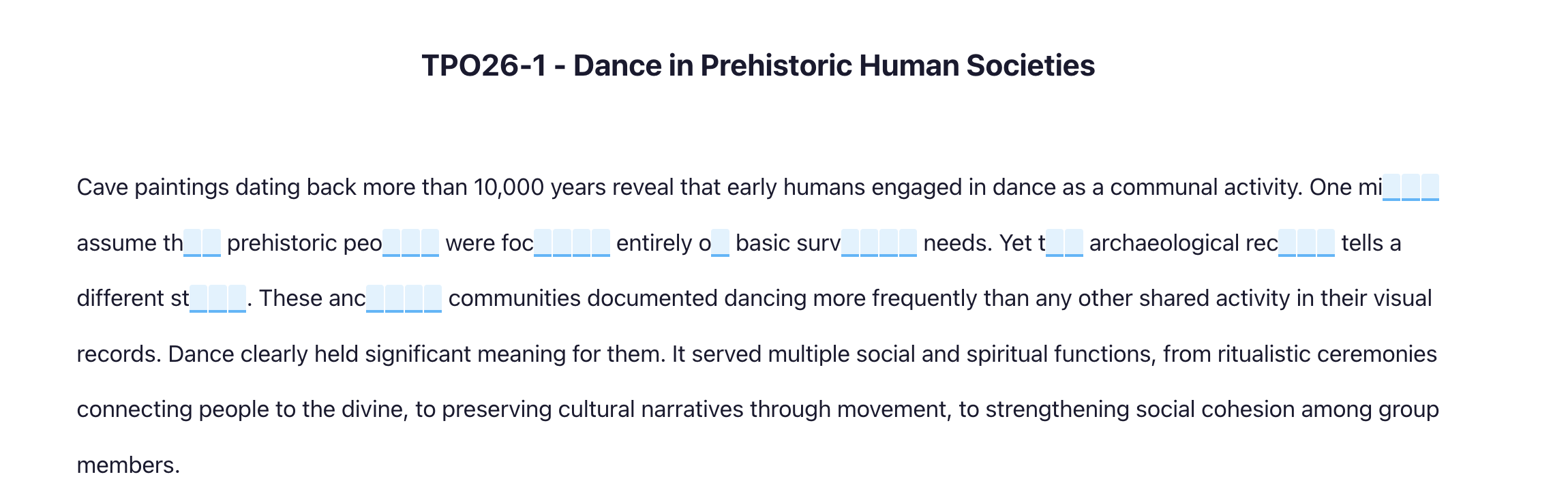
Reading — Complete the Words
Fill in missing letters to complete words in a short passage. Tests vocabulary recognition and spelling.
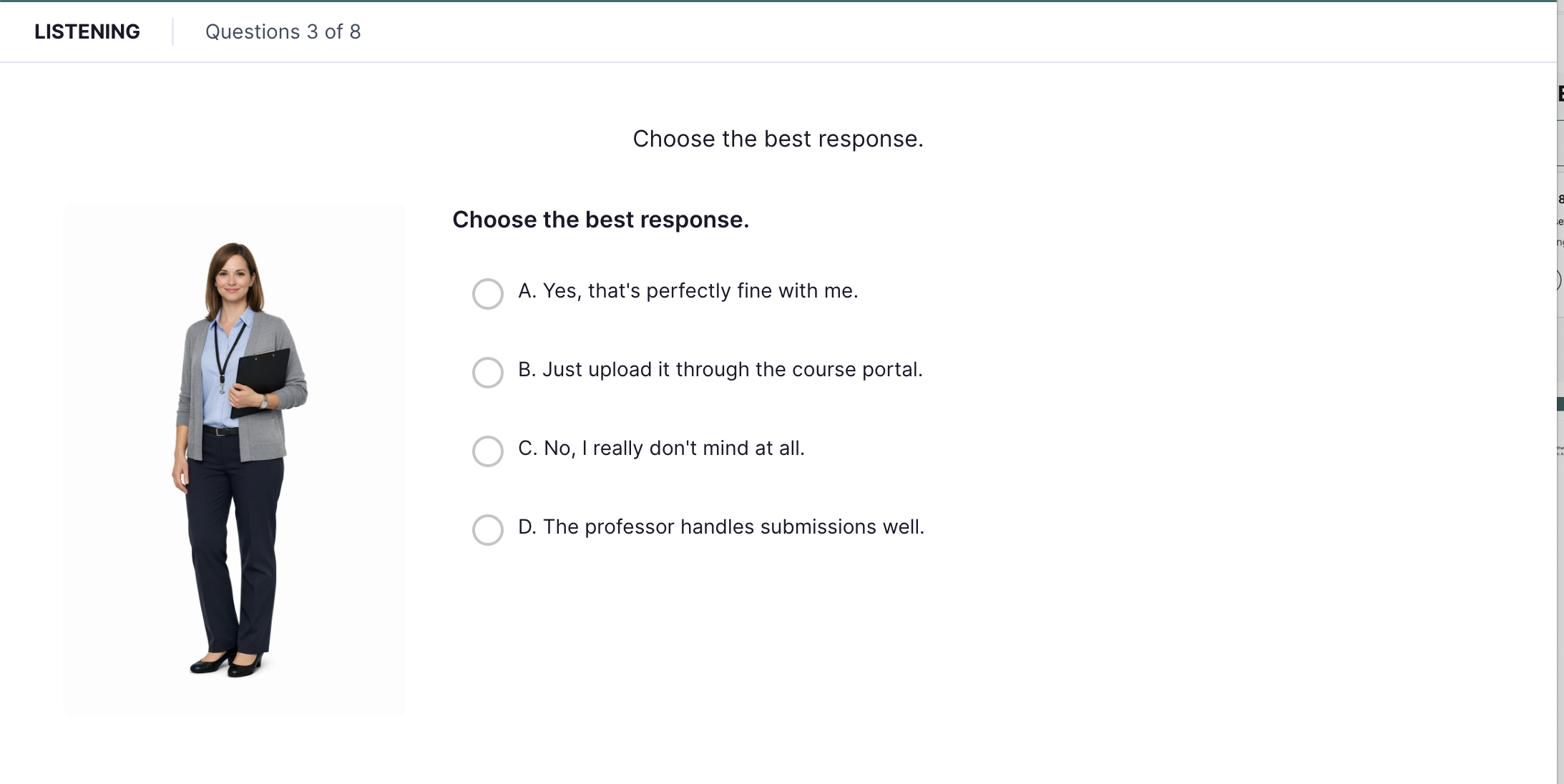
Listening — Listen and Choose a Response
Listen to a short statement or question, then choose the best response. Tests everyday listening.
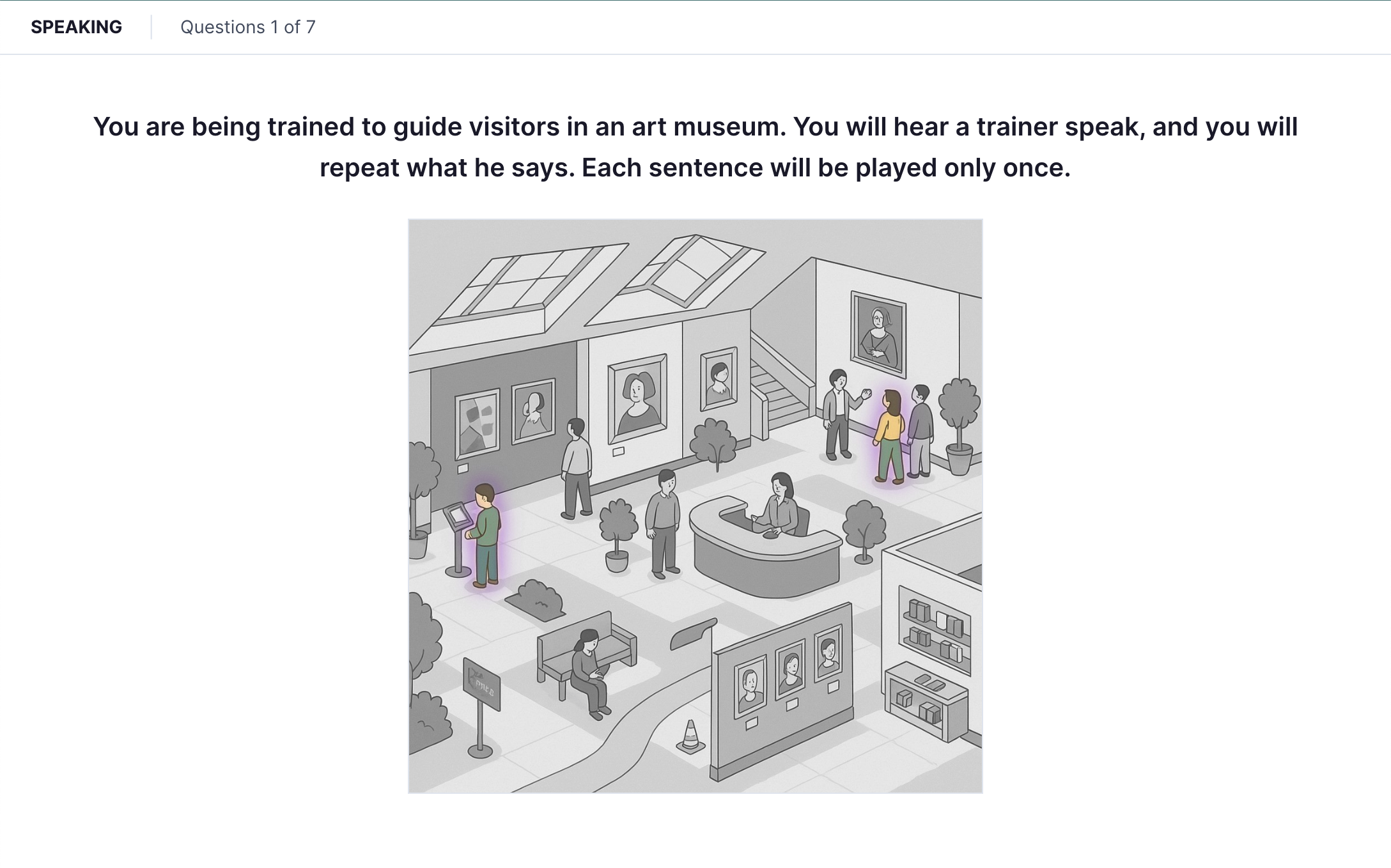
Speaking — Listen and Repeat (machine-scored)
Listen to a sentence, then repeat it aloud. Machine-scored against predefined answers — testing pronunciation accuracy and listening precision (7 items).
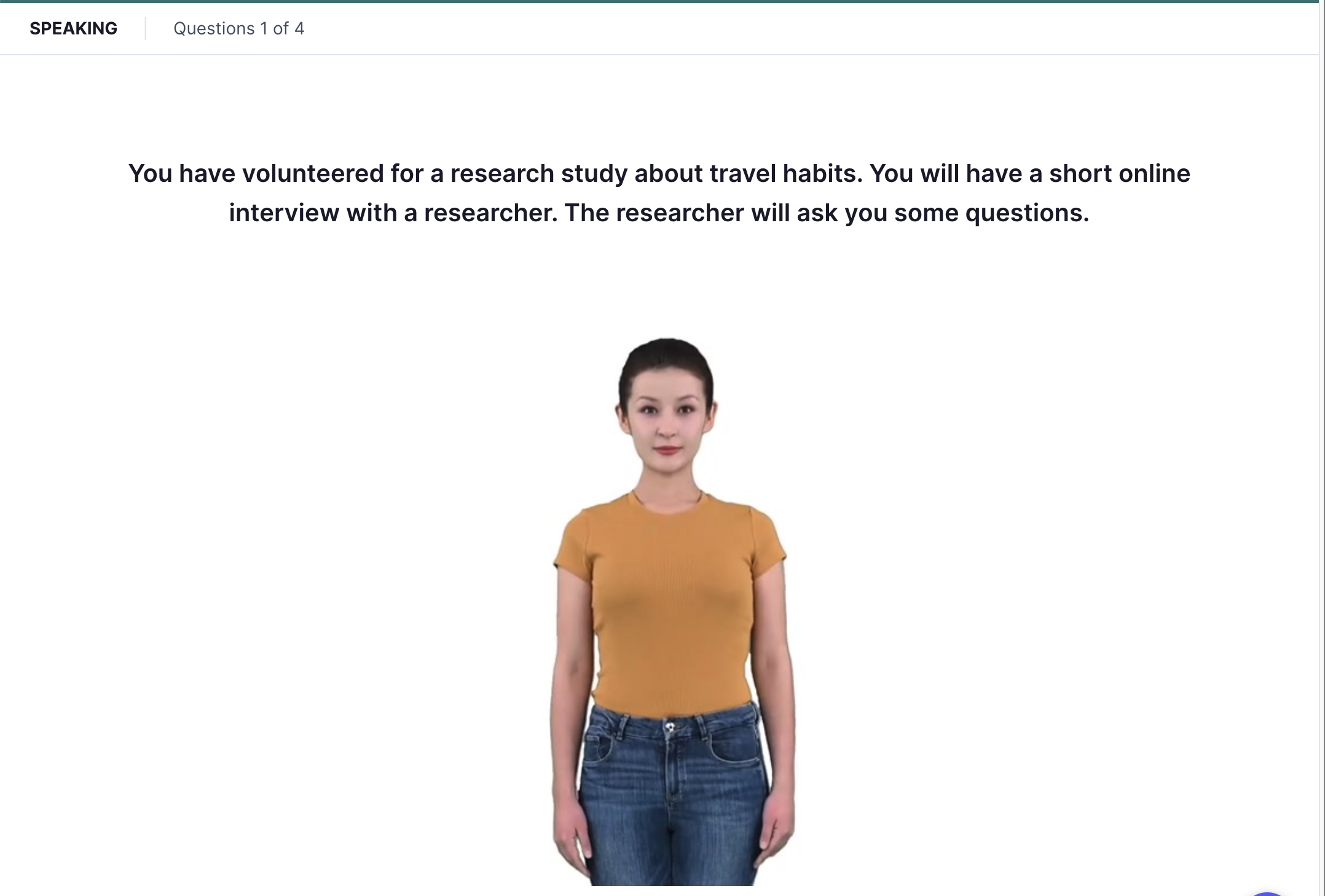
Speaking — Take an Interview (AI-scored)
Answer interview-style questions. AI-scored on fluency, coherence, grammar, vocabulary, and communication effectiveness (4 items).
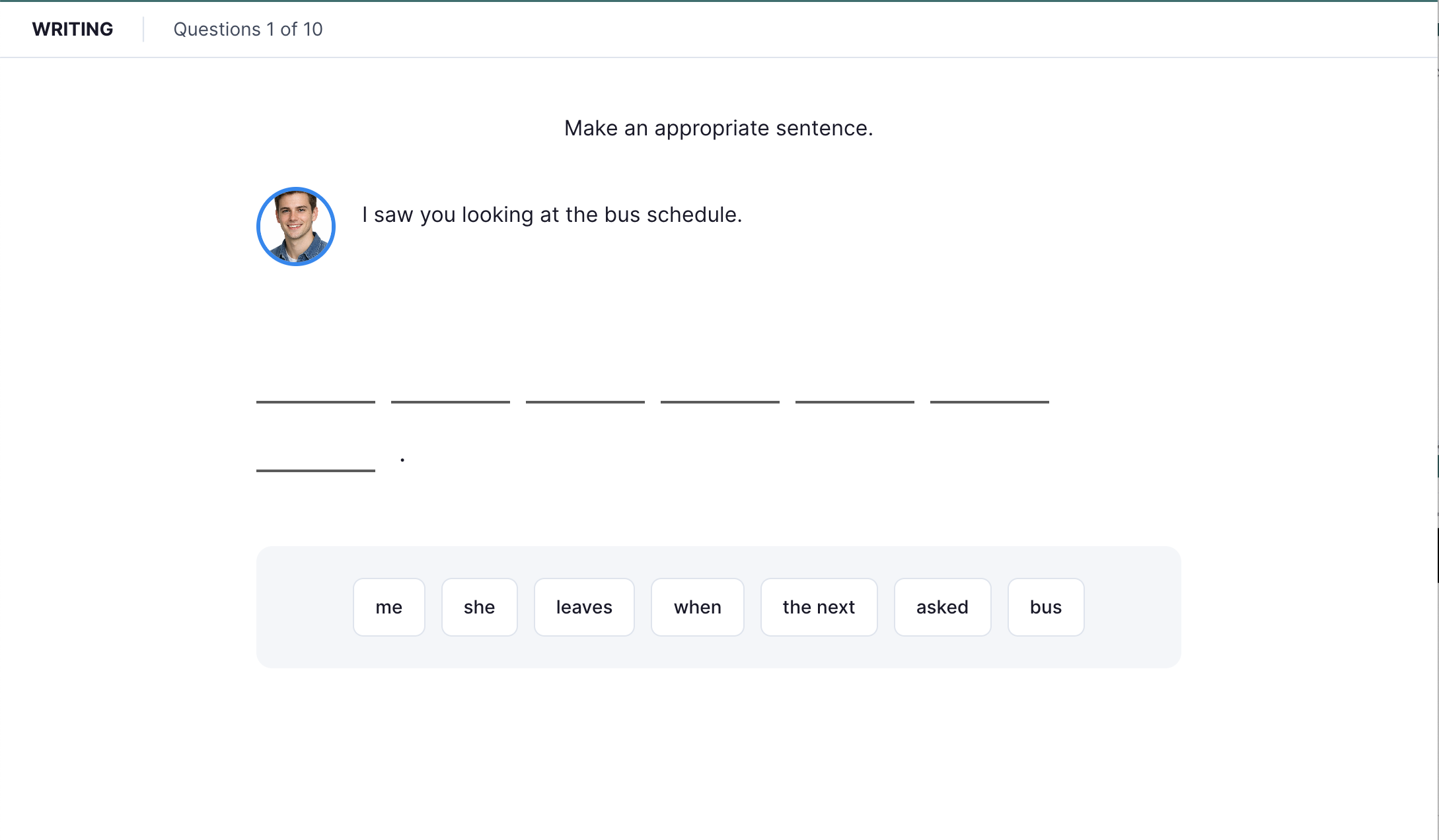
Writing — Build a Sentence (machine-scored)
Rearrange words into a grammatically correct sentence. Machine-scored on sentence-level grammar and syntax (10 items).
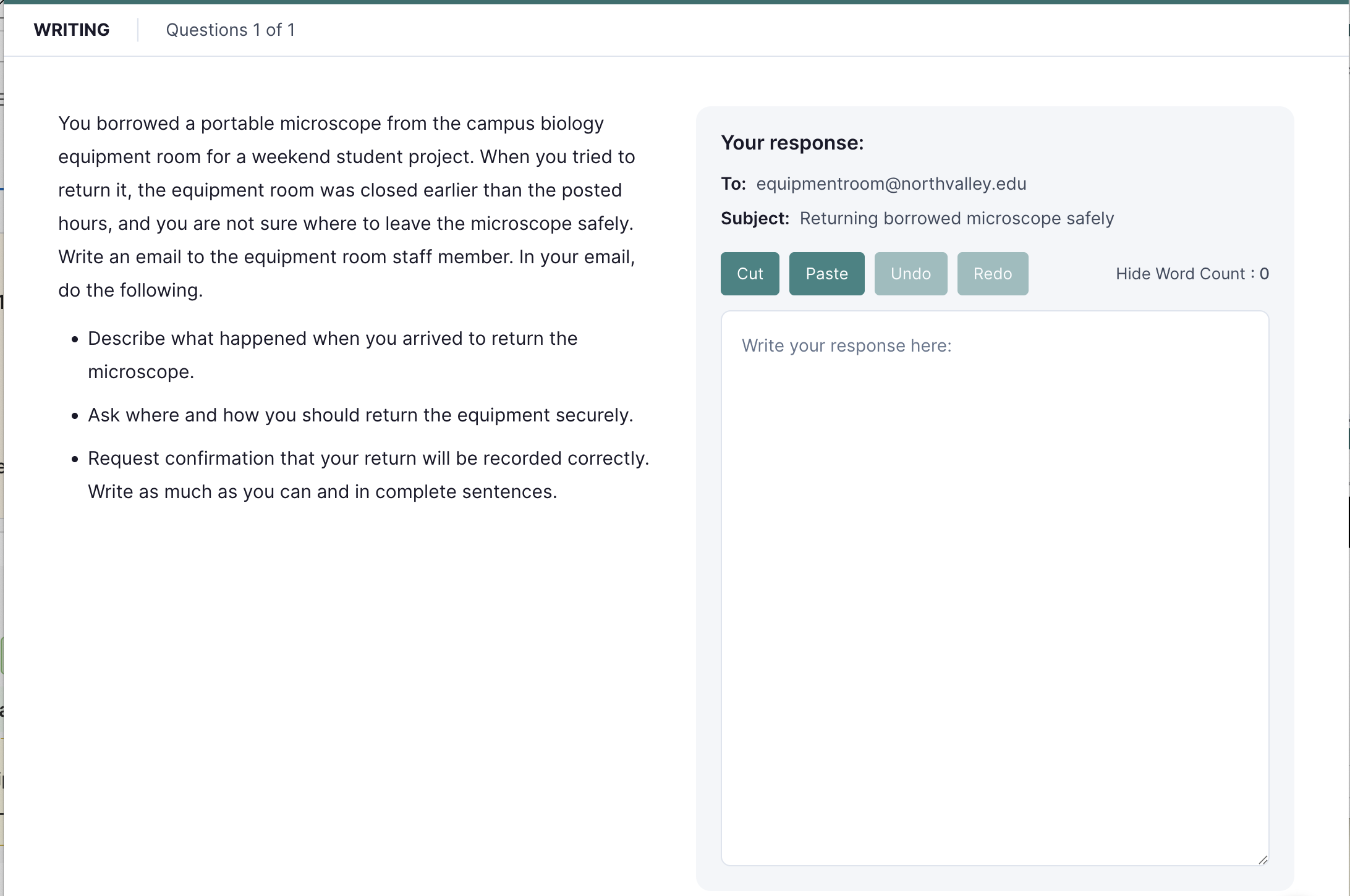
Writing — Write an Email (AI-scored)
Write an email response to a given prompt. AI-scored on organisation, tone, grammar, and communication effectiveness.
Screenshots from ETS TOEFL iBT practice materials. Task names, counts, and AI-vs-machine scoring labels verified against the April 2026 ETS Test Blueprint and the Official Guide (Pocket Edition).
How to Prepare for TOEFL 2026
Because the format is new, preparation strategy matters more than ever. Here's a step-by-step approach:
Step 1 — Take a Diagnostic Test
Use an official ETS practice test or a high-quality third-party test that reflects the 2026 format. Identify which sections need the most attention before building your study plan. Official ETS practice resources.
Step 2 — Learn the New Band Score Scale
Understand the target band (and CEFR level) for your programs on the 1–6 scale. Check if your universities have updated their minimum requirements for the 2026 format.
Step 3 — Practice Speaking with AI Feedback
Speaking is often the hardest section to improve alone. Tools like LingoLeap give you AI feedback on fluency, coherence, and vocabulary, typically within 1–2 minutes — so you can practice anytime, not just with a tutor.
Step 4 — Simulate Test Conditions
Do full-length timed practice tests in a quiet environment. For adaptive sections, use a simulator that adjusts question difficulty. Review every mistake — don't just check the answer, understand why.
Practice TOEFL Speaking — Get Detailed AI Feedback
LingoLeap's TOEFL Speaking practice simulates real test conditions and gives you detailed feedback on every response. Free to start.
Start Practicing FreeFrequently Asked Questions
When did the new TOEFL 2026 format take effect?⌄
ETS launched the redesigned TOEFL iBT in January 2026. If you're registering for a test date from January 2026 onward, you'll take the new format. Check ETS's official site for the exact implementation date for your region.
How is the new overall score calculated on the 1–6 scale?⌄
Per the ETS Technical Manual, the overall test score is the average of the four section band scores (Reading, Listening, Writing, Speaking). Both section scores and the overall score are reported on a 1–6 band scale in 0.5 increments. Universities typically compare overall bands against their own minimums — often via the CEFR mapping.
Do I need to prepare differently for the adaptive sections?⌄
Your core skills — reading comprehension, listening accuracy — remain the same. What changes is pacing strategy: since you cannot go back in adaptive sections, answer each item carefully before moving on. The April 2026 ETS Blueprint confirms a router-plus-module structure but does not publicly disclose the routing thresholds or scoring algorithm, so the most defensible strategy is steady accuracy across the whole section — particularly in the shared router. See our TOEFL MST Strategy guide for a deeper look.
Are TOEFL 2026 scores accepted by all universities?⌄
Most institutions that previously accepted TOEFL iBT scores accept the 2026 format, but not all. Oxford accepts only TOEFL iBT tests taken before 21 January 2026, and Cambridge does not list TOEFL for undergraduate entry. ETS notifies institutions of the new score scale, but check each program's current policy — especially if its admissions page still references the legacy 0–120 score scale.
How long does it take to receive TOEFL 2026 scores?⌄
Scores are typically available within 72 hours of your test date, per the ETS Technical Manual. You'll receive your scores online via your ETS account.
Can I still send my old TOEFL scores (0–120 scale) to universities?⌄
Yes. ETS retains score records for 2 years, and older scores on the 0–120 scale remain valid within that window. ETS is expected to publish an official concordance between the legacy 0–120 scale and the new 1–6 band scale — until then, treat any side-by-side comparison as an approximation and verify cutoffs with each institution.
Related Guides
TOEFL 2026 Format: Full Breakdown
Detailed look at every section, task type, and timing in the new format.
TOEFL 2026 Test Structure
How Reading, Listening, Writing, and Speaking fit together in 2026.
TOEFL 2026 Score Scale Guide
What the new 1–6 band scale means and how it maps to CEFR.
TOEFL Format Overview
General guide to the TOEFL iBT format for all years.
TOEFL 2026 vs. Old TOEFL: Key Differences
Side-by-side comparison of what changed and what stayed the same.
Free TOEFL Mock Test (2026 Format)
100+ full-length tests in the new format; PQ26-1 opens with a free account.
Sources
All facts on this page are verified against official ETS documentation: